Hermann Hesse and the I Ching: The Glass Bead Game and Hexagram 4
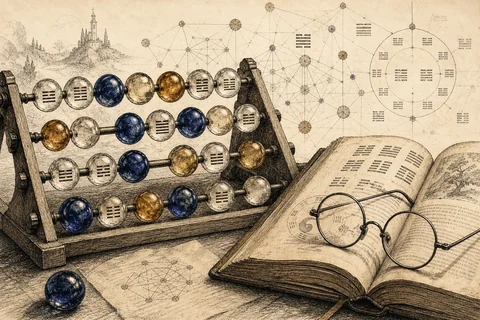
In 1925, Hermann Hesse — already famous for Siddhartha but still nearly two decades from the Nobel Prize — wrote a short, intense review of Richard Wilhelm's new German translation of the I Ching. He called it "an event." Over the following twenty years the book reshaped his thinking, surfaced in his correspondence, and finally became the structural keystone of his last and longest novel, The Glass Bead Game.
The 1925 review
Wilhelm's two-volume I Ging, Das Buch der Wandlungen appeared in 1924. Hesse — then living in Montagnola, recovering from an exhausting decade — read it through within weeks of publication. The review he wrote for the Neue Rundschau, dated early 1925, is short but unusually personal for him.
He describes the I Ching as one of the very few books in his life that he expects to read again every year until his death. The Wilhelm translation, he writes, is not merely a translation: it is a "transposition," an act of patient cultural midwifery that took twenty-two years of the translator's life and that gives the German-speaking reader access to a wisdom literature otherwise unreachable.
What is striking in the review is how quickly Hesse names the book's function. He does not call the I Ching a divination manual; he calls it a tool of self-knowledge. The hexagrams, he writes, are mirrors. You ask the book about your situation; what comes back is a configuration in which you recognize, with strange precision, the shape of what you already half-knew but could not articulate.
The essay on Hexagram 4
A few years later Hesse returned to the I Ching in a more sustained piece: Bemerkungen zu Hexagramm 4 des I Ging — "Remarks on Hexagram 4 of the I Ching." The hexagram in question is Meng (蒙), Youthful Folly — a mountain over water, the image of a young person whose vision is clouded but who can be taught.
Hesse takes the hexagram personally. He reads its judgment — that the teacher does not chase the pupil; the pupil must come to the teacher — as a statement about the dignity of learning. He reads the line texts as a sustained meditation on the relationship between a young person's confusion and an elder's patience. He concludes the essay with a remark that anyone who has read his late novels will recognize as the seed of The Glass Bead Game: that a true teacher does not fill the pupil but arranges the conditions under which the pupil's own clarity can emerge.
"This hexagram speaks of education — but of an education that does not impose, that does not chase. The Master remains still; the pupil walks toward him. The book of changes already knew, three thousand years ago, what every honest teacher learns by middle age."
— Hesse, Bemerkungen zu Hexagramm 4 des I Ging (paraphrase)
Wilhelm and Hesse
The two men corresponded, though the relationship was less intense than Wilhelm's with Jung. Both Hesse and Wilhelm were Swabians; both had been formed by the same provincial Protestant intellectual culture; both had then traveled — Wilhelm physically, Hesse imaginatively — into the East.
When Wilhelm died, prematurely, in 1930 at the age of fifty-six, Hesse wrote one of the more substantial obituaries in the German press. He saw Wilhelm's life as a singular bridge: a Protestant missionary who had ended up serving as the most reliable conduit through which classical Chinese thought reached the German-reading world. The translation of the I Ching, Hesse wrote, was "the most significant book published in German in this century."
This is hyperbole. Hesse knew it was hyperbole. But it was the kind of hyperbole he reserved for books that had genuinely changed his interior life.
Castalia and the I Ching
Das Glasperlenspiel (The Glass Bead Game, also published in English as Magister Ludi) was written in the late 1930s and published in 1943, in wartime Switzerland. It depicts a future intellectual order, Castalia, in which the most accomplished scholars devote their lives to a "Glass Bead Game" — an art form that combines all the cultural heritage of humanity into a single combinatorial language.
The structural model of the Glass Bead Game has multiple sources — music, mathematics, calligraphy — but the I Ching is the most explicit. Hesse states in the novel that the early Bead Game players studied "the I Ching with its sixty-four signs of metamorphosis" alongside Pythagorean ratios and counterpoint. The Game itself is a system of meaningful combinations of cultural signs; the I Ching is the original example of such a system.
The 64 hexagrams of the I Ching are a closed combinatorial space — every yin/yang configuration of six lines, no more, no less, each meaning something. The Glass Bead Game is the same form taken to an enormous scale: every meaningful combination of cultural elements, played as a single living grammar. Hesse's debt is structural and acknowledged.
The Elder Brother
The novel includes a character known only as Der ältere Bruder — the Elder Brother — a Castalian scholar who has retreated to a small house in a bamboo grove specifically to study the I Ching. When Joseph Knecht, the novel's protagonist, visits him for a year of training, the Elder Brother lives in a small Chinese-style hut, dressed in Chinese clothes, consulting the I Ching daily.
Knecht learns to cast hexagrams with yarrow stalks, learns the Wilhelm translation by heart, and absorbs from the Elder Brother a way of thinking in which every situation is a momentary configuration of forces that will resolve into another configuration. This is a faithful summary of the Confucian / Wilhelmian reading of the I Ching — not Hesse's invention but his careful transcription.
The Elder Brother is, in part, a literary portrait of Richard Wilhelm. He is also, structurally, the teacher figure that Hesse described in his essay on Hexagram 4: the Master who remains still, while the pupil walks toward him.
A Nobel novel built around a Chinese oracle
When the Swedish Academy awarded Hesse the Nobel Prize in 1946, the citation specifically mentioned The Glass Bead Game. The novel that secured Hesse's permanent place in world literature is a novel in which a 3000-year-old Chinese book of changes occupies the central scaffolding.
This is a fact that Western literary criticism, dominated until recently by readings of Hesse as a German Romantic, has tended to underplay. But it is not a small fact. Without the I Ching, the Glass Bead Game has no model. Without Wilhelm's translation, Hesse would not have had access to the I Ching in a form he could read deeply. And without Hesse's review of 1925, an entire generation of German-language readers might have come to Wilhelm's book years later, or not at all.
The line of influence runs: Confucian commentators → Wilhelm → Hesse → the Nobel committee → an entire mid-century generation of European readers who took the I Ching seriously, in part because Hermann Hesse had told them it deserved to be taken seriously.
The translation Hesse called "the most significant book in German this century"
I Ching AI includes the full Wilhelm German translation that Hesse reviewed and consulted, alongside the original Chinese, the English Wilhelm-Baynes rendering, and a complete Japanese translation. An AI trained on 200,000+ characters of commentary helps you read each hexagram with the same depth Hesse described in his essay on Meng.
Download I Ching AI