Bob Dylan and the I Ching: From Greenwich Village to "Changing of the Guards"
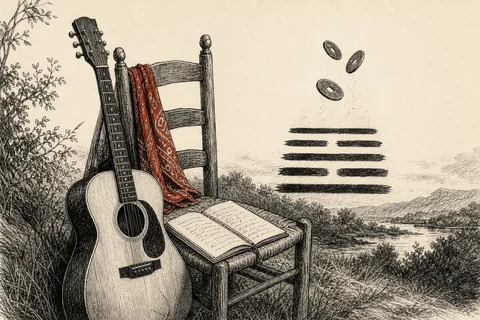
Bob Dylan's relationship with the I Ching is more diffuse than John Cage's deliberate compositional system or Philip K. Dick's plot-determining oracles. He never wrote about the Book of Changes at length; he never claimed it had structured a record. But it was unmistakably present in his milieu, it surfaced in his interviews from the late 1960s onward, and it left fingerprints on at least one of his strangest and most beautiful songs.
A Greenwich Village book
When Robert Zimmerman arrived in New York City in January 1961 — nineteen years old, a college dropout from Hibbing, Minnesota, soon to be Bob Dylan — the Bollingen edition of the Wilhelm/Baynes I Ching had been on American bookshelves for a little over ten years. In the Greenwich Village folk milieu Dylan entered, it was a recognized text. Allen Ginsberg, Dylan's near-immediate elder by some years and one of his most important friends from this period, owned a copy and used it. Poets Diane di Prima and Anne Waldman consulted it. The book passed hand to hand among artists who knew that what looked, on the surface, like a divination manual was actually a portable wisdom literature with a structure unlike anything in the Western canon.
It would be strange if Dylan, embedded in this circle, had not at least leafed through a copy. The evidence that he did goes well beyond what would be embarrassing absence: people who knew him in the mid-1960s remember an I Ching on his shelf. What is less clear is how seriously he took it. Dylan was, and is, a magpie. He gathered intellectual material rapidly, used it for as long as it interested him, and moved on.
What Dylan said in interviews
The clearest documentary evidence comes from a 1971 conversation between Dylan and the music journalist Anthony Scaduto, who was then preparing the first major biography. Speaking informally, Dylan described the I Ching as "the wisest book that's ever been written" — a remark Scaduto recorded with the matter-of-factness that suggested Dylan had said it before. The 1976 Robert Shelton biography, No Direction Home, contains a similar reference, again presented as a sentiment Dylan repeated rather than improvised.
In a 1978 interview with Playboy's Ron Rosenbaum, Dylan returned to the book briefly, treating it as something obviously valuable rather than something requiring explanation. He did not describe a method. He did not say he cast hexagrams about lyrics. What he said, repeatedly, was that the I Ching belonged to the small category of books that had not stopped being useful to him.
This is the kind of endorsement that is easy to underestimate, because it is so casual. Dylan was, by 1978, careful about what he said. The remark survives because he meant it.
"Changing of the Guards"
Street-Legal appeared in June 1978. The album opens with "Changing of the Guards" — a six-and-a-half-minute song with a structure unusually formal for Dylan: eight verses of eight lines each, every line written in a register somewhere between prophecy and parable.
Scholars and devoted listeners have read the song as a sustained extended metaphor on transition. The imagery includes a king with a "long suffering throne," "merchants and thieves, hungry for power," "stripes on her shoulders" (a soldier), "wounded by the moon," and a closing vision of "renegade priests and treacherous young witches" being "deceived into bloody fires." The mood is liminal: an old order ending, a new one not yet begun, with characters who do not know which side they are on.
This is not, structurally, an I Ching consultation in the way Cage's Music of Changes was. But the song's central image — a "changing of the guards" — is exactly the situation that the I Ching exists to describe. Several hexagrams (49 Ge, "Revolution"; 18 Gu, "Work on the Decayed"; 7 Shi, "The Army") map closely onto the song's content. The atmosphere of the song — heightened, almost ceremonial, treating the moment of social transition as a sacred crisis — is the atmosphere the I Ching brings to any moment of change.
Whether Dylan consulted a specific hexagram while writing the song is not knowable. Whether the I Ching's vocabulary for transitions is in the song's bloodstream is harder to deny.
George Harrison and the chain of recommendation
There is a small piece of musical-historical lore worth recording, although its details are imprecise. Multiple people in the late-1960s rock orbit remember that Bob Dylan recommended the I Ching to George Harrison; that Harrison, already exploring Hindu thought, took up the Wilhelm/Baynes seriously; and that several of Harrison's late-Beatles and early solo lyrics carry I Ching imagery as a result. "The Inner Light" (1968) draws explicitly on Lao Tzu rather than the I Ching, but Harrison's interest in Chinese sources was, by his own later accounts, prompted in part by Dylan.
The chain — Wilhelm → Bollingen edition → Greenwich Village → Dylan → Harrison → millions of pop listeners — is a small one, but it is real. A surprising fraction of how the I Ching reached the late twentieth-century English-speaking imagination passed through musicians who first heard of it from another musician.
What we can and cannot say
What we can say: the I Ching was part of Dylan's reading. He spoke of it warmly. It belonged to the small library of books he treated as permanent rather than temporary. The atmosphere of certain songs is consistent with someone who knew the Book of Changes well.
What we cannot say: that any particular song was composed by consulting hexagrams. Dylan did not work that way. His compositional method, by every account we have, was associative and torrential — words and images arriving in clusters, then edited down. The I Ching, if it shaped his songs, did so by being one of the books his subconscious had absorbed deeply enough to draw from without effort.
That is a less spectacular claim than the Cage or PKD case. But it is consistent with how an oracle book actually settles into a serious reader's life. Most people who use the I Ching long enough do not, at a certain point, need to throw coins for it to be at work in them. The book becomes part of the way they see situations. The hexagrams are how they think.
For a songwriter who, as Dylan once put it, "has a lot of love for the I Ching," that is probably exactly how it worked.
The book Dylan kept on his shelf, available now
I Ching AI includes the Wilhelm/Baynes English edition that circulated through Greenwich Village in the 1960s, alongside the original Chinese, Wilhelm's German translation, and a complete Japanese rendering. An AI trained on 200,000+ characters of commentary helps you cast and read hexagrams — for whatever you bring to it.
Download I Ching AI