Richard Wilhelm and the I Ching: The Missionary Who Translated China to the West
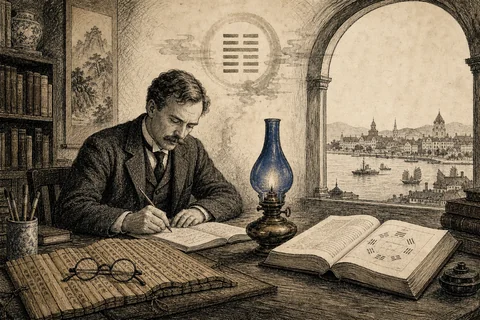
In 1899, a twenty-six-year-old Lutheran pastor named Richard Wilhelm boarded a steamer in Naples bound for Tsingtao, the German concession on the Shandong coast. He was sent to convert the Chinese to Christianity. Over the next twenty-two years, he became the most important Western translator of Chinese classics of the twentieth century — and, by his own admission, the Chinese had converted him.
A Swabian beginning
Richard Wilhelm was born in Stuttgart on May 10, 1873, into the strict, intellectually serious Pietist culture of Württemberg in southwest Germany. His father, a glass painter, died when Richard was a young child; his mother, Christiane, raised him alone in difficult circumstances. He studied Lutheran theology at the University of Tübingen — one of the great Protestant centers in Europe — and was ordained in 1895. He served briefly as a vicar in Wurmlingen, married Salome Blumhardt (granddaughter of the famous pietist healer Johann Christoph Blumhardt) in 1900, and accepted a mission post abroad almost immediately afterward.
The mission society that sent him — the Allgemeiner Evangelisch-Protestantischer Missionsverein, later known as the East Asia Mission — was unusual among nineteenth-century missionary bodies. Its theology was liberal; its aim was less to convert souls than to engage in serious cross-cultural dialogue. Wilhelm was, in this sense, the right man for the right organization: a learned pastor who took foreign cultures seriously rather than as obstacles to be overcome.
Tsingtao, 1899
Wilhelm arrived in Tsingtao in 1899, two years after Germany had seized the harbor and surrounding territory as a colonial concession following the murder of two German missionaries in Shandong. The city was being built — German architecture, German breweries (the famous Tsingtao Brewery dates from 1903), German naval infrastructure — atop a Chinese population whose cooperation the Germans needed.
Wilhelm threw himself first into practical work. He founded a German-Chinese school (the Deutsch-Chinesische Hochschule), helped run a small hospital, and learned Mandarin rapidly. But within a few years his attention had shifted in a way that would have surprised his sending society. He was no longer primarily interested in teaching Chinese students about Germany. He was interested in being taught about China — by Chinese teachers, in Chinese.
The decisive shift came around 1903, when Wilhelm began studying classical Chinese with the senior Confucian scholar and former imperial official Lao Naixuan (劳乃宣, 1843–1921).
Lao Naixuan, the teacher
Lao Naixuan was, by the time he met Wilhelm, an old man — a former member of the Hanlin Academy, the imperial body of the most senior Confucian scholars in China. He had served under the Qing dynasty in various administrative posts and, after the dynasty's collapse in 1912, had retreated into private scholarship. Their meeting was as improbable as it was consequential. A Hanlin scholar of the deepest classical tradition, working line by line through the I Ching with a German pastor from a small Swabian town.
The work pattern that emerged is one of the underrated wonders of cross-cultural translation. Lao would explain a passage in classical Chinese; Wilhelm would render it into German; the two would debate the German until Lao was satisfied that the meaning had survived the journey. The I Ching alone took them roughly ten years to complete. Wilhelm later wrote that everything important he understood about the book, he had learned from Lao.
The relationship is one of the few in modern intellectual history where a Western translator was, demonstrably, the junior partner. Wilhelm was the writer; Lao was the source. Wilhelm acknowledged this so thoroughly in his introductions that no serious scholar of the I Ching can read Wilhelm without also citing Lao.
The translations
Wilhelm's published translations from Chinese into German constitute one of the most ambitious one-man translation projects in modern European history:
- 1910
- Lun Yu (the Analects of Confucius), Kungfutse: Gespräche
- 1911
- Tao Te Ching, Laotse: Tao Te King
- 1912
- Liä Dsi (the Liezi)
- 1913
- Mengzi (Mencius)
- 1916
- Dschuang Dsi (the Zhuangzi)
- 1924
- I Ging, Das Buch der Wandlungen — the I Ching, in two volumes
- 1928
- Lü Bu We (the Annals of Lü Buwei)
The 1924 I Ching is the masterpiece. Wilhelm spent approximately twenty-two years on it — from his earliest study with Lao around 1903 until publication in 1924. The two-volume German edition presents the original judgments and line texts in close translation, followed by the canonical Ten Wings, with substantial introductions and commentaries that draw on Lao's classical-Confucian reading and on Wilhelm's own attempt to render the text comprehensible to a Western reader without flattening its strangeness.
Frankfurt and the China Institute
Wilhelm returned to Germany permanently in 1921 — the year Lao Naixuan died — bringing with him manuscripts, books, and twenty years of accumulated understanding. In 1924 he took up a professorship at the University of Frankfurt, the first chair of Sinologie at that university, and in 1925 he founded the China-Institut, a research and teaching institute dedicated to serious engagement with Chinese thought.
The China-Institut became a hub. Hermann Hesse visited; Carl Jung gave lectures there; the young Hellmut Wilhelm, Richard's son, began the sinological career that would later make him one of the great American China scholars. The institute also hosted Chinese visitors, including the philosopher Hu Shi and the painter Chiang Yee. It was, briefly, one of the most important sites of Sino-German intellectual exchange.
A premature death
Wilhelm did not live to see most of what he had set in motion. He had contracted amoebic dysentery during his last years in China, and the disease returned chronically once he was back in Germany. In late 1929 his health collapsed; he died in Tübingen on March 2, 1930, at the age of 56. He had completed the I Ching translation, established the China Institute, and trained a son who would carry his work forward. He had not yet written most of the books he intended to write.
Hermann Hesse's obituary, which appeared in the German press a few days later, called Wilhelm "a bridge between East and West" — and added that the bridge had been built by one man, almost alone, and that nothing comparable was likely to be built again in their century.
Carl Jung's 1949 foreword to the Wilhelm/Baynes English edition of the I Ching, written nearly two decades after Wilhelm's death, is partly an act of remembering. Jung had known Wilhelm well in the 1920s; the foreword's tone is grieving as well as expository. He writes of Wilhelm as the rare Westerner who had been changed by China rather than merely informed about it.
The bridge that did not collapse
The Wilhelm I Ching, published in 1924, has now been continuously in print for more than a century. Cary F. Baynes's English translation of Wilhelm's German, published by Bollingen in 1950 with Jung's foreword, is the book most Western readers still mean when they say "the I Ching." Hellmut Wilhelm's own scholarly works (Eight Lectures on the I Ching, Heaven, Earth, and Man in the Book of Changes) extend his father's reading. The Wilhelm tradition is, effectively, the way the I Ching exists in modern Western thought.
This is an enormous claim to make about a single Swabian Lutheran pastor who happened to be sent to a German concession in 1899. But it is true. Without Wilhelm, the I Ching that Jung read, Hesse reviewed, Cage built music from, Philip K. Dick wrote a novel with, and Bob Dylan kept on his shelf, would not have existed in a Western language at all — or if it had, it would have existed in a thinner and less philosophically alive form. The history of the I Ching in modern Western thought is, in significant part, the history of one man's twenty-two years of work with one Chinese teacher.
Read the I Ching in Wilhelm's translation
I Ching AI includes the full original Wilhelm German translation alongside the English Wilhelm-Baynes rendering, the original Chinese text, and a complete Japanese translation. An AI trained on 200,000+ characters of commentary helps you read each hexagram in the tradition Wilhelm and Lao Naixuan established.
Download I Ching AI